
10 Questions with Will Emmett

10 Questions with Will Emmett
This is the second interview in my series of chats with the people behind some of Australia’s most interesting new tech start ups. I caught up with Will Emmett of meemeep.com and was impressed by his intelligence and his vision for meemeep and the collaborative consumption movement. At 23 he’s wise well beyond his years.
1. What is MeeMeep? When and where did the idea come from?
Meemeep is a social network that connects people on the move with people with things to move.
The idea came to my uncle three years ago who noticed all the empty space in the cars and trucks next to him whilst driving. He investigated the idea and found that the courier market was quite over inflated and saw a huge opportunity existed for a shake up in this space.
2. How long has it taken to implement? What has been the biggest setbacks along the way?
It’s taken three years to bring the idea from concept to reality. The biggest setbacks have been operational like trying to create a great user experience on the website, but we’ve also been challenged with building trust and safety into our brand as well as communicating what is effectively quite a complex offering.
Some of the difficulties we have faced stem from not having much to model the idea on. You know when we started out, the term “Collaborative Consumption” didn’t even exist to describe the business model we were trying to achieve. It wasn’t until six months into the project that Rachel Botsman released her book and the term and the idea was popularized. In fact I remember listening to talking business on a Qantas flight and hearing her being interviewed about “What’s Mine is Yours” which had just been released and I was instantly able to draw the links between what we were attempting to achieve and the “Collaborative Consumption” movement she was describing.
3. What are your thoughts on the Collaborative Consumption movement?
I look at the Coll Cons idea as having two sides. The first being the movement itself and the people that are championing it and secondly the outcome of what Coll Cons actually achieves. I think it’s important to note that the outcome of the idea itself is so much more powerful than the actual movement at the moment. When you think about it Coll Cons really is a perfect economic example of creating shared value amongst a huge range of people.
4. Where’s Coll Cons at in Australia currently? Are the consumers ready?
Australians are such a strange bunch. I’ve actually had this exact conversation with a number of people in the Coll Cons space over the last few weeks. I think for the size of our country we’re actually a fair way along the path. I think there’s always going to be leaders that are in front of Australia but I think we’re gaining in the Coll Cons space pretty quickly as far as our adoption to the use of it is concerned.
(Are we at a disadvantage with our low population density?)
We’re less dense, we consume more, we have a much bigger impact on the environment than most other countries in the world. I think we are a little bit disadvantaged but where there’s disadvantage there’s opportunity. Using meemeep as an example, the low population density and the great distances between cities means that travel is more expensive for us and that we also drive more often and cover further distances than other countries which manifests in an economic opportunity.
5. What other Coll Cons Start Ups in Australia have you been impressed by?
There are two that instantly spring to mind: Ziilch and Openshed. I really like what they’re both trying to achieve and the passion they both have for their mission is admirable.
6. What are your thoughts on the current global explosion of start ups? Where has this come from? Are we in a bubble?
I think that it’s very easy to deny that you’re in a bubble when you’re in a bubble… However we’re probably not there yet and things are a little different this time around. The best thing about this explosion of tech start ups has been that they’ve all been driven by revenue generating companies which is unique in comparison to the last two dot com booms. And whilst past tech booms have been based around the technology itself I think now the start ups are using the tech to solve real world problems.
7. Let’s Move on to Marketing. What do you think makes a good brand?
It’s a very big question…The common theme that I think runs through a good brand is a belief by the consumer that the brand represents something that is good, something that is bigger than themselves, and something that they can be a part of. I think a good brand has a deep connection with their customer. No matter how far away you are from that brand you still feel connected in some way.
8. Is the role brands play in people’s lives changing?
Yes. Absolutely. I think religion is out and brands are in.
People are looking for something to believe in. There’s a void that brands are filling in and in some instances it’s going to explode. The good news though is that the open, transparent nature of the internet is forcing brands to live up to the values they preach so perhaps it’s not as dangerous as it might have once been!
9. How are you marketing MeeMeep?
We’re a company that lives very closely to its brand. At a fairly deep level we know that we’re all about helping people help each other and this naturally flows through in every single thing we do. Our goal is to have our message spread naturally by providing a great service and being true to our values. We’re putting our message out there in the hope that it resonates with like minded individuals to create a community that is self sustaining.
9.5. Is it hard to connect to the people that are actually willing to transact on meemeep rather than just like the idea?
Yeah and that’s where the idea of being ‘seamless’ comes in to it. Having businesses that fit into and help people’s lives rather than expecting people to change their ways to embrace a new idea. We still have a long way to go in making our product entirely seamless for the consumer but it’s definitely one of the biggest issues that Coll Cons start ups face. The key is to put yourself in the stakeholders shoes at each touchpoint and ask “where’s the value for me?”
10. What / Who Inspires You?
I’m lucky that I have a great number of people very close to me in my life who inspire me. Generally speaking it’s the people that are willing to push the boundaries, be unpopular at times and who have a very strong resolve to what it is they’re trying to achieve – the trouble makers!
With regards to Meemeep and the Coll Cons movement I’m inspired by the fact that I’m a part of something that really has the power to change the world in a very significant way.
Biggest Stop Animation in the World – (But Nokia Still Sucks)
Gulp. The world’s largest stop-motion animation shot on a Nokia N8. from Nokia HD on Vimeo.
Biggest Stop Animation in the World – (But Nokia Still Sucks)
To promote the Nokia N8 Nokia have launched the “World’s Largest Stop Motion Animation.”
How much did this cost?
What’s the ultimate goal here? Obviously they want to communicate the quality of their camera. But who the hell cares? What’s the endgame?
Increase sales? Branding? Loyalty?
Why?
What happens if this campaign succeeds in trial, or product research?
The answer: People will be led to a second-rate product and their perception of Nokia will be harmed.
So why bother launching at all? Divert the money on launching beautiful expensive campaigns like this into R & D. Develop a product that is ready to compete with the likes of the iPhone and Android, THEN create the campaign.
Take a loss on the N8.
By talking it up you’re only shooting yourselves in the foot.
You’re not ready to talk.
Answer our Problems Instantly or We’ll Move On
When a salesman doesn’t pick up his phone. When a news article is too long. When you have to fill out too many details. When delivery time is less than overnight. When a service cant be explained in three steps…
We move on.
With the near infinite information and subsequent choices the internet has delivered us, businesses and content creators have windows of opportunities with their customers that are getting smaller everyday.
We’re at information overload. We need answers to our problems instantly or we’ll look elsewhere.
Curation, the hot topic of the moment, will help solve the problem of noise. So if you’re good enough to be given your chance to speak, you’d better speak in a way that allows for the impossibly short attention span of your customers.

Will Territory Play a Part in the Success of a Coll Cons Start Up?
Collaborative consumption, the idea of consumers having access to products as opposed to ownership, is big. It’s a growing movement that has the potential to define this century and for entrepreneurs, now is the time to get in.
As an Australian watching this space evolve, I have always wondered whether territory will impact on the different category segments. Will “collcons” businesses be global? Or will the location based nature and the “community” ethos limit international expansion? Sure this depends on the segment. AirBnB for instance, where your spare bed is rented to travellers, will obviously be more efficient if there is one global hub. So too will swap networks like swap.com dealing in small, easy to mail goods like DVD’s and books.
But what about businesses that rely on neighbourhood proximity?
Take the household goods sharing segment for example. Neighborgoods is a leader in the US where you can rent or borrow a lawnmower/drill/vacuum/whatever from your neighbour. If they expand to Australia, how will consumers choose between them and locally run offerings like RentWant, or Open Shed? Will the “community” nature of these businesses give Australian based operations an advantage? Will search results yielding listings in San Fransisco discourage a user?
The answer: Not really.
When businesses rely on social networks to facilitate their offerings, the only thing that truly matters is whether or not they have a critical mass of users. A Melbournian wanting access to a vacuum cleaner only cares about two things. 1) Whether or not there is a vacuum listed on the site and 2) Whether it’s listed close to him.
For Australian start ups their advantage lies in being a first mover. And in the race towards critical mass, this is big. There’s huge potential out there but like all social networks there’s only room for one or two segment leaders. The race is on.
Great Web Design is a Must – Help an Aussie Start Up with Potential
Great web design is now a standard. A hygiene factor to simply state you are open for business. The internet, the great leveler, means you can not get away with being average anymore. Given that every shop is now essentially next door to each other, why would you enter one with smashed windows and cracked paint?
findauniform.com.au is a fantastic, homegrown idea. An open community for exchanging second hand uniforms – brilliant. But they have a problem. I can’t stay on their site for more than a glance before needing to look away. It’s harsh but they’re not alone (see my own poor effort) and it’s an all too common problem with otherwise solid Aussie startups.
I’ve spoken with them and I want to help. This is a cracker of an idea getting global coverage from the likes of Rachel Botsman.
So questions to the cloud:
1. Do you know any designers or developers wanting a cool project with a site that has the potential to explode? (Budget is tight but there is budget!)
2. Do you have any experience with Elancers or virtual assistants abroad that they could build an ongoing relationship with?
Please pass this on and get in contact with me or them with any suggestions.

The Word Engagification is Bullshit, The Idea is Not.
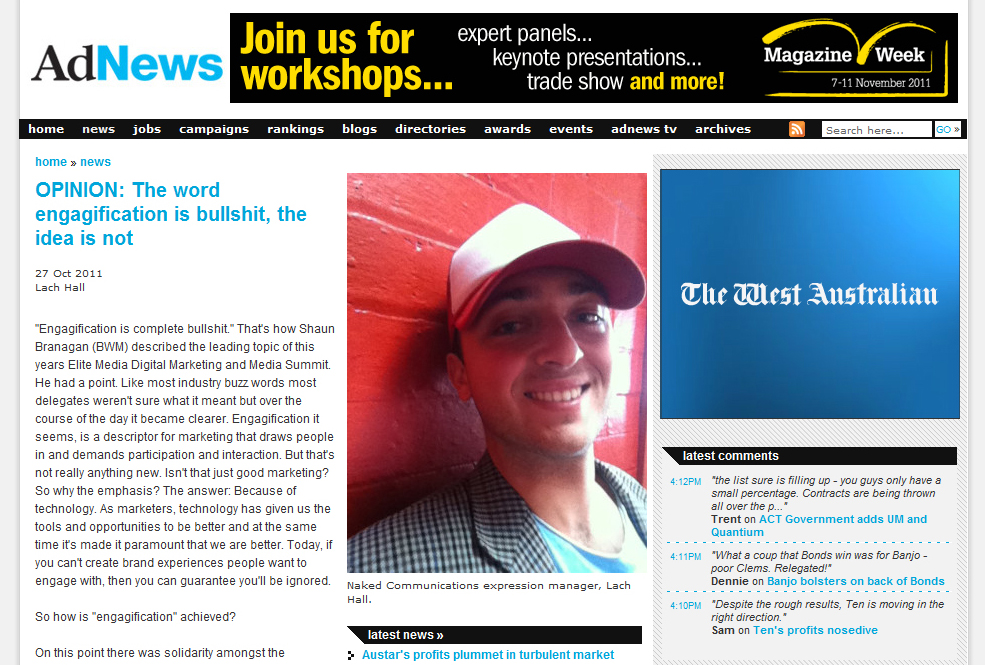
“Engagification is complete bullshit.” That’s how Shaun Branagan (BWM) described the leading topic of this years Elite Media Digital Marketing and Media Summit. He had a point. Like most industry buzz words most delegates weren’t sure what it meant but over the course of the day it became clearer. Engagification it seems, is a descriptor for marketing that draws people in and demands participation and interaction. But that’s not really anything new. Isn’t that just good marketing? So why the emphasis? The answer: Because of technology. As marketers, technology has given us the tools and opportunities to be better and at the same time it’s made it paramount that we are better. Today, if you can’t create brand experiences people want to engage with, then you can guarantee you’ll be ignored.
So how is “engagification” achieved?
On this point there was solidarity amongst the speakers:
- Know your audience
- Be useful to them
This isn’t new. But this is marketing at its core and it’s too often forgotten.
The point was reinforced throughout the day with speakers showcasing different dimensions of usefulness such as utility, information and entertainment through their case studies. Brannagan explained howU.S.ski resorts had created the Epic Mix app to ‘gamify’ your day on the slopes. Simon Small (Visual Jazz) demonstrated how Huggies have created a compelling online community for Mothers through “truly understanding your customer and building content that gives them utility.” Alex Burke (TigerSpike) talked about how the Woolworths App owes it’s success to solving customers “pain points” and of course we also learnt via the Bing / Jay Z Decoder case study and NAB Break Up Case study that being useful isn’t limited to being practical – information and entertainment are also valued.
Another recurring theme throughout the day was that the winning “engagement” formula doesn’t exist. Instead, it’s about trial and evolution of strategy and luckily in the digital world you can afford to make mistakes. On this note Small offered a summary: “start small, trial and learn”.
So whilst the word ‘engagification’ might be unclear, Elitemedia’s conference offered some compelling insights on how marketing can engage customers. Mea Cole (Droga 5) reminded us that people will always do what they want to do when and where they want to do it. And that’s the key. At Naked we believe great marketing occurs at the overlap between what people want to do and what we as marketers want them to do.
“If no one is criticizing you, it’s because you’re not doing anything important.”
It’s very easy to avoid criticisms in life-do as Elbert Hubbard says, “Do nothing. Say nothing. Be nothing.” If you’re being criticized, it’s because you’re actually on the radar, and not laboring in obscurity as most men are. The bigger you get, the bigger target you become, and the more arrows will come your way. Instead of seeing criticism as a reason to change, celebrate its arrival as a marker of your success.
Excerpt From “Being Your Own Man” Article in The Art of Manliness
10 Questions with Georgia Beattie – Lupe Wines
10 Questions with Georgia Beattie – Lupe Wines
Georgia Beattie is on the brink of something big. In fact it already is big. At just 25 she has experienced successes most people only dream of. I caught up with her for a coffee and walked away inspired. Lots of entrepreneurs have lofty ambitions. Georgia doesn’t. They are real and she is almost there.
1. What is Lupe and where did the idea come from?
We’re a single serve wine packaging company with a house label product called Lupe. The idea came to me when I was at the bar of a Melbourne festival and realized they didn’t serve wine. I asked the bartender why this was to which he replied it was just “too difficult”. “With beer and spirits we can throw them on ice and serve them up in no time”. I immediately saw the opportunity for wine in more accessible packaging.
2. What’s your background? Did you always want to run your own business?
Yes, for as long as I can recall. I’ve always wanted to be my own boss. The concept of growing someone else’s business seems foreign to me. I come from a family of wine, my father has a winery and a string of boutique bottle shops so delving into this project I had some natural advantages. I also studied entrepreneurship at RMIT which helped me achieve the right mindset but in reality, the skills that would have really come in handy in setting up Lupe would have been in engineering! Luckily I was able to find some investors that were trained in this area.
3. I understand part of your course was spent in the US. How does the entrepreneurial scene differ between here and there?
Yes, I spent 8 months at Babson College which is a highly regarded entrepreneurial school in Boston, MA. The people there were incredibly inspiring, many of which had projects which had gone on to successful IPOs. There’s a tremendous culture of entrepreneurship over there that we don’t really have in Australia. Everyone’s so encouraging and open in sharing contacts and information. Here on the other hand, it seems entrepreneurial endeavors are often frowned upon for being too risky, entrepreneurs themselves are quite cagey with their ideas and when you make it, you’re often shot down due to the tall poppy syndrome! It’s a massive difference in culture. When I look back at my time at Babson, simply being around such an inspiring culture I feel it gave me the confidence to ‘go in hard’ with my idea when I came home. And in reality it’s the only option you really have. If you don’t back your idea 100% and go all in, who will?
4. Who’s in the team?
In the immediate circle there’s myself, my two principle investors looking after the production, my brother in sales and five employees on the production line. We then have our distribution partners in Japan and Singapore.
5. How did you go about raising VC and bringing the product to life? How long has it taken?
When I first had the idea 2 years ago, I went about trying to produce a prototype on my own which turned out to be incredibly difficult as the injection moulding technology needed to produce the appropriate wine glass didn’t really exist. The company supplying me the lids put me in touch with a business in the UK who were working on a similar project and had custom built a machine capable of producing what we were after. Within two weeks I had been to London, negotiated the Asia Pacific rights to the packaging technology and had a machine custom built for my own purposes. So there was an initial outlay required from myself to get it ready to pitch.
Once we began pitching the idea to investors, the word spread very quickly since the idea had legs and we weren’t after a ridiculous amount of money. I soon realized that lots of people were willing to throw money at the idea but what I really needed were investors with appropriate experiences that would add value to the business. In particular I needed investors with manufacturing expertise and distribution connections in which I was lucky enough to find.
6. Where do you see the market for Lupe?
In Australia our main focus is on outdoor events where serving in glass is prohibited and quick customer service is essential. We’ve already been in discussions with some of Australia’s biggest festivals all of which have replied “it’s about time”. We also see retail as a secondary opportunity. We’re cautious however in how we position ourselves there. We’re sensitive to the traditional nature of wine the product and the rituals that go along with it. My father’s bottle shop has proven an invaluable resource for testing what works and what doesn’t in this regard. We’re also taking cues from other markets a little further developed than us. In the UK the product has been very well received in theatres and cinemas so we’ve recently begun conversations there.
Our biggest opportunity however, and where we spend most of our time and effort is in Asian retail. We already ship 1-2 container loads a month to our distributors in Japan and Singapore and we’re in negotiations with South Korea and China as we speak. The reason for the demand is twofold: the Asian wine market is experiencing tremendous growth as they become more westernized and since it’s less established they’re far more open to the new packaging format. For them, the idea of buying a 750ml bottle of wine to share at a restaurant makes perfect sense, but to buy for your home, where you might only have one glass a night, seems strange. We aim to have setup a manufacturing facility in China within the next two years.
7. Are you a packaging business or a wine business?
Good question. We are a packaging business. Lupe, (our house brand single use wine) is a consumer facing brand but in reality its just a tool to prove the concept and the demand of our packaging solution and capabilities to the established wineries. We don’t have the capital, time or experience needed to launch and distribute a new wine brand. In saying that I do believe that there is room in the market for a brand of wine with a more youthful character to it such as Lupe but it’s not our priority or core business.
8. What are the best and worst things about having you own business?
The best is the challenge itself and the little rushes you get when you get that little bit further down the track towards achieving your goals.
There really is no worst thing. If I was to say anything it would be that it’s hard not to get emotionally involved in the business when it’s your own. You take it to heart when someone dismisses the idea or you get down on yourself when you’re spending time on something un-business related when you know there’s so much work to do. You can never really switch off. And sometimes it’s hard to level with people about your challenges because so few people have been through what you do. To counter this, I’ve set up a range of mentors who constantly kick my arse in to line and remind me to see the business from a birds eye view and remember how simple it really is what Im doing and not to get bogged down on the little stuff.
9. What’s been the biggest thing you have learnt throughout your journey
The biggest is never to assume anything. When planning I’ve found I need to consider all possible outcomes and strategize appropriately.The others would be around looking after my health – healthy body, healthy mind. De-stressing and moving forward from an issue is really important too. I can do this over a morning jog most of the time.
10. Who /What inspires you to do what you do?
It’s not really someone or something, it’s the challenge. I love the game. I’m chasing an empire and every day I can’t get out of bed quick enough to start chipping away at it.
Why Agencies Should Get Into Bed With VCs
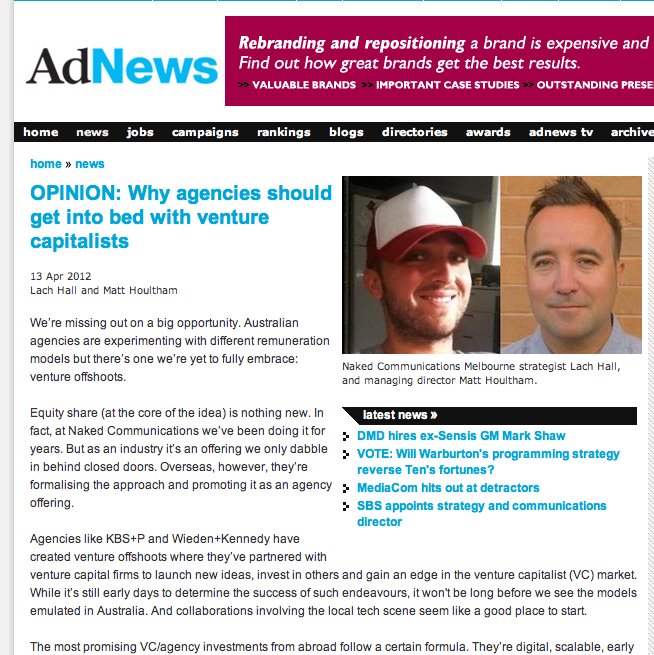
Why Agencies Should Get Into Bed With VCs
As appeared in AdNews 13th April 2012
By Lach Hall and Matt Houltham
We’re missing out on a big opportunity. Australian agencies are experimenting with different remuneration models but there’s one we’re yet to fully embrace: venture offshoots. Equity share (at the core of the idea) is nothing new. In fact at Naked we’ve been doing it for years. But as an industry it’s an offering we only dabble in and dabble in behind closed doors. Overseas however they’re formalising the approach and promoting it as an agency offering. Agencies like KBS+P and Weiden + Kennedy have created venture offshoots where they’ve partnered with venture capital firms to launch new ideas, invest in others and gain an edge in the VC market. While it’s still early days to determine the success of such endeavors it wont be long before we see the models emulated in Australia. And collaborations involving the local tech scene seem like a good place to start.
The most promising VC/Agency investments from abroad follow a certain formula. They’re digital, scalable, early stage and stand to win big from agency networks. For all involved the idea makes perfect sense. It’s digital and early stage so it’s cheap to get a prototype up and running, you’ve got expert brand builders on tap to set the marketing right from the start and most importantly you’ve got a product that can be plugged into an existing agency network that can fast track revenue generation. A great example of this is KBS + Partners investment in Adapt.ly, a business which allows brands to deploy ads simultaneously across social media ad platforms. The other less obvious benefit of following this formula is that from the agencies perspective, the whole endeavour is an exercise in education and branding. Not only does the agency look innovative for simply offering such a service but in a market moving more and more towards digital every day, investing in digital startups means that whether or not you back a winner you a) appear on the cutting edge, b) expose yourself (and your clients) to knowledge and innovation and c) you commence conversations with the clients of tomorrow.
Like abroad, the emerging tech scene in Australia presents the greatest opportunity for agency/VC offshoots. Last year sites like 99designs and kaggle made headlines raising millions in US venture funding and now there are lots of Australian funds hunting for their successors. We’ve got early stage “accelerators” such as StartMate, AngelCube and PushStart, tech development partners like Polenizer and Blue Chilli and various other more traditional funds all focused on Aus start-ups.
But like the US scene, there’s danger of overcrowding. With every new VC fund that enters the market, the competition for promising start ups becomes more fierce. This is where Australian agencies have an opportunity. Whilst Australian VC programs are currently promoting legal partnerships and marketing “mentors” none have leveraged the extensive expertise and commercial contacts found in an established ad agency (not to mention the agency’s own brand). I don’t think it’ll be long before we see this hit the Australian scene.
How to feel Miserable as an artist.
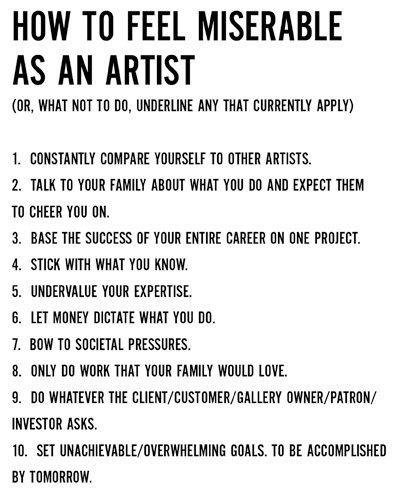
How to feel Miserable as an artist. By awesome musician, businesswoman and all round legend @dallasfrascca http://www.dallasfrasca.com/